Address
Liguang Industrial Zone,Liguang Community, Guanlan Street, LonghuaDistrict, Shenzhen, Guangdong, China
Work Hours
Monday to Saturday: 8AM - 6PM ( Beijing Time: GMT+8 )
Sunday : Closed

Address
Liguang Industrial Zone,Liguang Community, Guanlan Street, LonghuaDistrict, Shenzhen, Guangdong, China
Work Hours
Monday to Saturday: 8AM - 6PM ( Beijing Time: GMT+8 )
Sunday : Closed

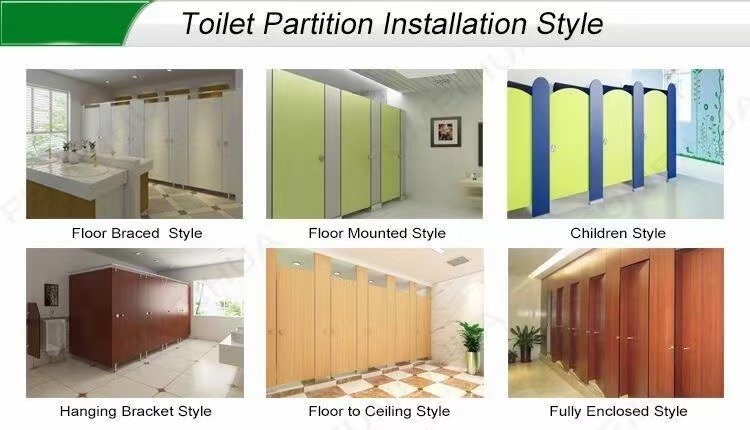
In modern interior design, people are increasingly focusing on aesthetics, safety, and health. So, what are the common styles of public restroom partitions? This article will introduce the most common types available on the market and explain where each is best suited.
Type 1: Classic Floor-Standing Style (The Most Traditional and Stable)
You’ve surely seen this style before—the door panels and partitions extend all the way to the floor, supported by stainless steel or nylon bases, with a gap of about 10–15 centimeters from the floor.
Advantages: Simple installation, excellent stability, and relatively low cost.
Suitable Settings: Renovations of older buildings with limited budgets, as well as factories, warehouses, and other locations where hygiene requirements are not as strict.
Type 2: Suspended Style
In this style, the door panels do not touch the floor but are suspended from overhead beams, leaving the floor completely unobstructed.
Advantages: Extremely convenient for cleaning with no hard-to-reach areas, and it offers a modern, upscale appearance—a design favored by many high-end shopping malls and office buildings.
Suitable for: Shopping malls, airports, and high-end office buildings, especially those with inherently smooth and level floors.
Type 3: Supported Style
This design falls between the floor-mounted and suspended styles. The partitions and door panels are raised a certain height off the ground (typically 15–20 cm) and supported by stainless steel or nylon legs.
Advantages:
The height off the ground is sufficient to prevent water splashes when mopping, and the panels are less prone to moisture damage.
Ventilation at the bottom allows the floor to dry quickly, reducing the risk of mold growth.
Installation is less demanding than the suspended type, as it does not require specific wall or ceiling conditions; it can be installed on standard lightweight partition walls.
Visually clean and sleek, without the prominent gap at the bottom found in floor-to-ceiling designs.
Suitable for: Schools, hospitals, swimming pool locker rooms, sports venues, gyms, etc.
So, what’s the best material to use for bathroom partitions? Currently, HPL is the most widely used option on the market. This material is waterproof, fire-resistant, and impact-resistant, and comes in a wide variety of patterns, making it the top choice for most applications. If you have a different opinion, please feel free to share it with us in the comments section.
