Address
Liguang Industrial Zone,Liguang Community, Guanlan Street, LonghuaDistrict, Shenzhen, Guangdong, China
Work Hours
Monday to Saturday: 8AM - 6PM ( Beijing Time: GMT+8 )
Sunday : Closed

Address
Liguang Industrial Zone,Liguang Community, Guanlan Street, LonghuaDistrict, Shenzhen, Guangdong, China
Work Hours
Monday to Saturday: 8AM - 6PM ( Beijing Time: GMT+8 )
Sunday : Closed

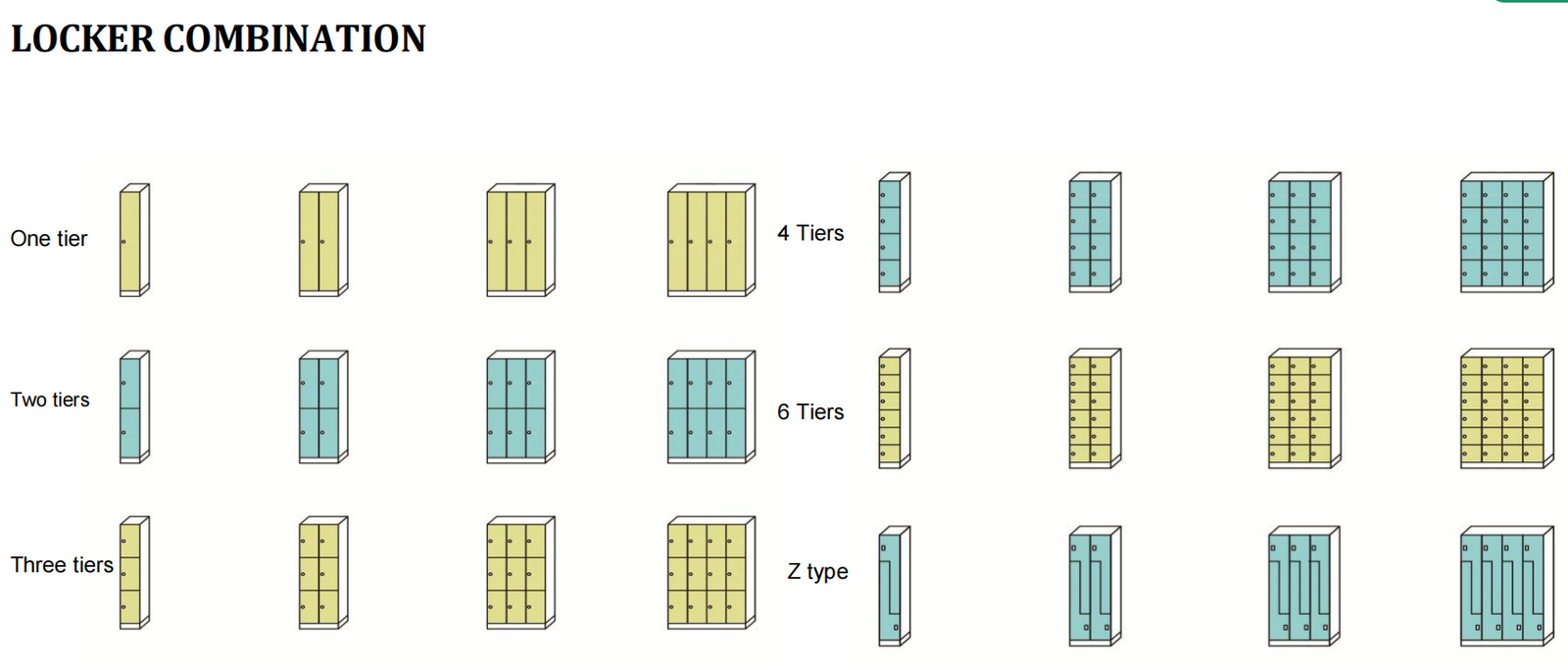
As an international sales representative, I’m often asked by buyers, “What are the standard dimensions of your lockers?” But in reality, the more critical question should be: “How much storage space do my members actually need?” Let’s take gym lockers as an example and analyze their sizes.
The design of public changing rooms—especially in high-traffic, high-usage gyms—is about more than just finding a place to store belongings; it’s also about user experience and spatial efficiency. Today, I’d like to analyze the logic behind choosing locker sizes for gym settings from a professional perspective.
1. What are the general standard sizes?
Standard sizes are designed based on the needs of most gyms. However, standard sizes are not the only option. Some items require more space, such as tennis rackets or yoga mats, so larger lockers are needed. If the locker is only used to store small items like cell phones or wallets, the storage space can be much smaller.
If your gym is located in a downtown office district and your primary clientele consists of “white-collar workers looking to work out after work,” then your lockers need to accommodate hanging suits and shirts. In this scenario, locker depth is critical. To hang garments without causing wrinkles, a locker depth of at least 500mm–600mm is recommended. If the depth is only 400mm, the hangers will need to be placed at an angle.
2. Selecting Gym Locker Dimensions
When designing public locker room layouts, we typically recommend dimensions based on the following three factors:
Height: Standard public lockers are typically between 1800 mm and 1900 mm in height. This height accommodates most hanging garments (with approximately 850–950 mm needed for tops) while avoiding wasted headroom or user inconvenience caused by excessive height. For swimming pools or wet areas, where towels and other items need to be stored, the height can be appropriately reduced to 1500–1800 mm.
Depth:
Economy/High-Density Locations: If the space is limited and only standard athletic wear is stored, 400 mm is a common dimension.
Comfort/High-End Gyms: Depths of 500 mm or 600 mm can be selected. Of course, larger isn’t necessarily better; the design should primarily be based on the items to be stored.
Width: Single-door widths are typically 300 mm or 400 mm. For women’s gyms, where members may carry larger handbags, the width can be increased to 500 mm.
3. Space Utilization
There’s an important question to consider: Should we install more small lockers or a few large ones?
My recommendation is that if foot traffic is extremely high during peak hours, prioritize ensuring there are “enough” lockers. However, if conditions allow, a mixed layout can be adopted: for example, 70% standard lockers (W300×D500) combined with 30% extra-deep and extra-wide lockers (reserved for VIPs or instructors). This approach not only meets basic turnover needs but also enhances the experience for certain users.
4. In addition to size, pay attention to the following details
Aisle Space: No matter how well-designed the lockers are, don’t forget that opening the doors requires space. We recommend leaving at least 800mm of aisle space in front of the lockers to ensure that bending down to retrieve items or high foot traffic does not cause crowding.
Ventilation Design: Since clothes are damp after exercise, it’s best to design ventilation holes inside the lockers.
Internal Configuration: Adjustable shelves, hanging rods, dedicated shoe compartments, and built-in charging ports can all enhance the customer experience.
If you have any better design ideas or suggestions about changing room lockers, please share them in the comments section.
